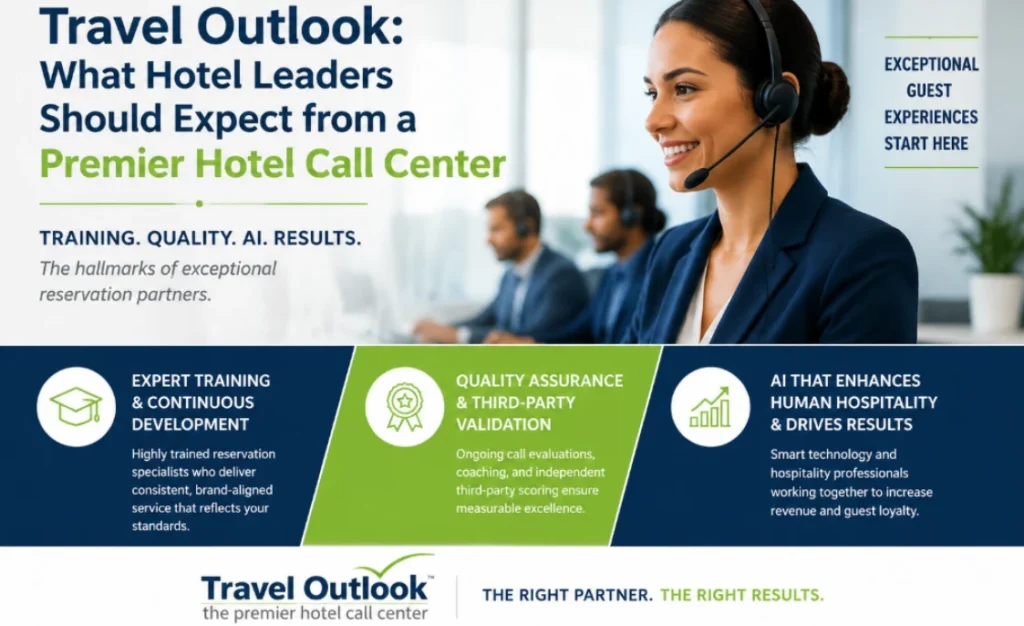
Hospitality AI Needs More Than Answers: A Travel Outlook Guide to Smarter Guest Service
Why Personalization, Context, and Human Escalation Matter More Than Basic Chatbots in Hotels
By John Smallwood, President of Travel Outlook
At a Glance:
Hotels have moved beyond static FAQ pages and simple chatbots, but many AI tools still fall short in hospitality because they were not built for the complexity of hotel guest service.

Travelers do not just want quick answers, they want reassurance, personalization, and seamless support when plans change or requests become more nuanced. That is why hospitality AI must go beyond FAQ automation.

The most effective solutions combine conversational intelligence, hotel-specific knowledge, and smooth escalation to live staff when needed.

Key Takeaways

• Generic chatbots can answer simple questions, but hotel guest service often requires more personalization, context, and judgment.
• Hospitality AI should understand property-specific information, respond naturally, and know when to escalate a guest to a human.
• The best AI platforms support front desk teams and reservation staff by handling routine inquiries without compromising the guest experience.
• In hospitality, the difference between basic automation and hospitality-specific AI can directly affect guest satisfaction, booking confidence, and brand perception.
In Hospitality, Answering Questions Is Not Enough
Hospitality technology has long focused on helping guests get answers faster. That led to FAQ pages, website chat widgets, automated phone trees, and more recently, chatbots. Each was designed to improve efficiency, and in many cases they helped.
But hospitality is different.
Hotel guests are not simply checking an order status or resetting a password. They are planning vacations, coordinating business trips, confirming special requests, comparing room types, and deciding whether to book. That means hotel guest communication requires more than speed. It requires context, reassurance, and service.
A chatbot that simply returns a scripted answer may technically resolve a question. But if it does not understand what the guest is really asking—or what they need next—it can still create frustration, confusion, and lost opportunities.
In hospitality, answering questions is only the beginning.
Why Generic Chatbots Often Fall Short in Hospitality
The problem with many chatbots is not that they are bad tools. It is that they were never designed for the realities of hotel guest service.
Generic bots often struggle with the things that matter most in hospitality, including:
• Understanding property-specific questions
• Interpreting multi-part requests
• Responding naturally when guests change direction mid-conversation
• Recognizing when a guest needs reassurance or a live person
• Escalating without creating friction
A guest might ask whether a suite has a balcony, whether pets are allowed, whether late checkout is available, and whether the hotel can accommodate an anniversary surprise—all in the same conversation.
That is not a simple FAQ exchange. It is a hospitality interaction.
What Separates Hospitality AI From a Basic Chatbot
The strongest hospitality AI platforms stand apart in three areas: personalization, context, and escalation.
1. Personalization
Guests do not want generic answers. They want relevant answers.
Hospitality AI should be able to draw from property-specific knowledge such as room types, resort fees, pet policies, dining options, parking details, amenities, and brand standards. The more specific the answer, the more useful the interaction becomes.
Personalization also helps the guest feel like they are interacting with the hotel—not with disconnected software. In hospitality, that distinction matters.
2. Context
Guests rarely ask questions in perfectly neat, one-step interactions. They ask follow-up questions, shift topics, and explain situations in their own words.
Hospitality AI needs to understand those layered conversations.
A guest might say: “I’m thinking about staying in August for my daughter’s birthday. We’ll probably need two beds, and I wanted to know if you have connecting rooms and whether the pool stays open late.”
That is not one FAQ. It is a trip-planning conversation. Hospitality AI should be able to respond naturally rather than forcing the guest through separate scripted paths.
3. Escalation
Even the best AI should not try to handle everything.
Some conversations need a person, whether that is a complex reservation issue, a VIP request, or a service recovery situation. Hospitality AI should know when to step aside and hand the conversation off quickly and smoothly, without forcing the guest to start over.
In hospitality, escalation should not feel like failure. It should feel like service.
What Hospitality-Grade AI Looks Like in Practice
This is where purpose-built solutions such as Annette, The Virtual Hotel Agent™ fit into the picture.
Annette was designed specifically for hospitality environments where guests are not just looking for information, but often making booking decisions, planning travel details, and seeking reassurance that their needs will be handled properly.
Rather than relying on rigid scripts or generic answers, Annette helps hotels deliver more responsive guest communication by supporting tasks such as:
• Answering property-specific questions
• Assisting with reservation inquiries
• Routing calls intelligently
• Supporting multiple languages
• Sending follow-up texts when needed
• Transferring guests to hotel staff or reservation professionals when appropriate
Most importantly, Annette is designed to support the guest experience without forcing travelers through an impersonal, transactional interaction.
The Best Hospitality AI Supports Staff, Not Just Guests
One of the biggest misconceptions about AI in hospitality is that its purpose is to replace people.
In practice, the most effective hotel AI deployments do the opposite: they support the people already responsible for delivering the guest experience.
When AI can handle repetitive inquiries such as check-in times, parking questions, pet policies, amenity details, and simple reservation requests, hotel staff gain back time for the moments that require human judgment, warmth, and problem-solving.
That creates a stronger model: AI handles routine interactions and first-line support.
Hotel associates focus on complex guest requests, VIP interactions, service recovery, and high-value reservation opportunities.
This is where hospitality AI becomes most valuable, not as a replacement for service, but as a way to protect it.
What Hotels Should Evaluate Before Choosing an AI Guest Service Platform
As more hotels explore AI, the question is no longer whether automation belongs in the guest journey. The real question is what kind of AI can support the guest experience without compromising it.
Hotels should ask:
• Can it understand natural guest language?
• Can it answer property-specific questions?
• Can it support voice as well as text?
• Can it escalate gracefully to a human?
• Can it support reservation inquiries, not just FAQs?
• Can it reflect the hotel’s service standards and brand voice?
The answers to those questions will determine whether AI becomes a service asset or just another layer of friction.
Frequently Asked Questions (FAQs)
What is the difference between a hotel chatbot and hospitality AI?
A hotel chatbot is often a basic automated tool designed to answer common questions. Hospitality AI is broader and more sophisticated. It is designed to understand natural guest language, respond with property-specific context, support reservations, and escalate to hotel staff when needed.
Why are generic chatbots often a poor fit for hotels?
Generic chatbots may answer simple FAQs, but they often struggle with personalization, nuanced guest requests, and multi-step conversations. Hotels need AI that reflects the complexity of guest service, not just basic automation.
Should hotel AI replace front desk staff?
No. The strongest hospitality models use AI to support hotel staff by handling routine inquiries and after-hours requests while allowing employees to focus on complex guest needs and service delivery.
What should hotels look for in an AI guest service platform?
Hotels should look for AI that can understand natural language, answer property-specific questions, support voice and text interactions, escalate gracefully to humans, and align with the hotel’s guest experience goals.
See What Hospitality-Specific AI Looks Like in Practice
Guests expect more than fast answers. They expect conversations that feel helpful, relevant, and easy.
Annette, The Virtual Hotel Agent™, helps hotels deliver that experience by combining conversational AI with hospitality-specific knowledge, natural escalation, and 24/7 guest support designed around the realities of hotel guest service.
Schedule a demo to see how Annette can support your front desk, improve guest communications, and create a more personalized guest experience for every caller.

About John Smallwood, President of Travel Outlook | John Smallwood is President of Travel Outlook, The Premier Hotel Call Center™, and a recognized thought leader in hotel guest communications, conversational AI for hotels, hotel reservations, hotel call center operations, and hospitality technology. A veteran hotel owner, developer, and operator, John has spent decades helping hotels improve guest experiences, increase direct bookings, optimize reservation conversion, and maximize voice channel revenue.
After earning a BBA from New Mexico State University, John began his career with AT&T, where he gained valuable experience during the early years of the data revolution. He later combined his expertise in hospitality operations and technology to found Travel Outlook, creating one of the hospitality industry’s leading reservation services organizations focused exclusively on hotel guest communications. John also led the development of Annette, The Virtual Hotel Agent™, a guest-led conversational AI platform built specifically for hotels. Through his writing, speaking engagements, webinars, and industry collaborations, John helps hotel leaders understand how conversational AI and human expertise work together to improve guest service, strengthen reservation performance, reduce operational pressure, and create more personalized guest experiences. Learn more at LinkedIn.com/in/TravelOutlookVoiceReservations.

About Travel Outlook, The Premier Hotel Call Center™ | Travel Outlook is a leading provider of hotel call center outsourcing, hotel reservations services, conversational AI for hotels, and guest communication solutions. Serving as either a hotel’s primary or overflow reservations department, Travel Outlook combines highly trained hospitality professionals with hospitality-specific AI technology—including Annette, The Virtual Hotel Agent™—to help hotels answer every guest call, improve reservation conversion, increase direct bookings, and enhance the guest experience.
Known for its progressive approach to hotel reservations, call center performance, training, transparency, quality assurance, and hospitality technology, Travel Outlook helps hotels optimize one of their most valuable revenue channels: the voice channel.
Travel Outlook’s client portfolio includes many of hospitality’s leading brands and management companies, including Grand Casino Mille Lacs and Grand Casino Hinckley, Viceroy Hotel Group, Curator Hotels and Resorts, Outrigger, Proper Hospitality Group, MakeReady Experience, Pechanga Resort Casino, Ocean Edge, Shanty Creek, Sage Hospitality, Noble House Hotels, HEI Hotels, and many others.
By combining hospitality expertise with conversational AI, reservation sales best practices, and data-driven performance management, Travel Outlook helps hotels improve guest satisfaction, strengthen brand loyalty, increase direct revenue, and deliver exceptional guest experiences across every interaction. Learn more at TravelOutlook.com.
About Annette, The Virtual Hotel Agent™ | Annette, The Virtual Hotel Agent™, is a guest-led conversational AI platform designed exclusively for the hospitality industry. Purpose-built for hotel guest communications, Annette helps hotels answer every call, support reservations, reduce front desk workload, and deliver personalized guest experiences 24 hours a day, 365 days a year.
Powered by advanced conversational AI, natural language understanding (NLU), hospitality-specific knowledge bases, and intelligent call routing, Annette understands how real guests speak—including complex questions, multi-turn conversations, varying accents, and multiple languages. Unlike traditional IVR systems and basic chatbots, Annette engages guests in natural conversations that feel intuitive, helpful, and personalized.
Annette can answer property-specific questions, support reservation inquiries, assist with room availability, route calls intelligently, send follow-up text messages, communicate in multiple languages, and seamlessly transfer guests to hotel staff whenever human assistance is needed. By combining AI with hospitality expertise, Annette helps hotels improve call capture, increase reservation opportunities, enhance guest satisfaction, and create a modern guest experience that complements hotel teams rather than replacing them. Learn more at TravelOutlook.com/Annette.