
THE DEFINITIVE GUIDE TO CHATBOTS FOR CUSTOMER SERVICE, CONVERSATIONAL AI, AND GUEST-LED CONVERSATIONAL AI
BEYOND CHATBOTS: A TRAVEL OUTLOOK PERSPECTIVE ON THE FUTURE OF HOTEL GUEST COMMUNICATIONS
By John Smallwood, President of Travel Outlook
At a Glance:
For years, hotels relied on FAQ pages, scripted chatbots, and interactive voice response systems to help guests find information. Those tools improved efficiency, but they often shifted work to the traveler: search the website, choose the right menu option, use the expected keyword, or start over when the request did not fit the script.

Conversational AI changes that equation. It can interpret natural language, identify intent, retain context, and respond dynamically. Guest-led conversational AI advances the model again by organizing the experience around the traveler rather than the technology. The guest says what matters, in the way that feels natural, and the system follows the conversation.

Key Takeaways:

• Traditional FAQs, chatbots, and IVR systems answer within structures the hotel defines; conversational AI understands what the guest means.
• Guest-led conversational AI goes further by adapting the interaction to how travelers naturally speak instead of making travelers adapt to technology.
• Hospitality requires specialized AI because hotel conversations involve emotion, trust, accessibility, complex plans, and revenue-sensitive decisions.
• Hotels are moving beyond chatbots to meet 24/7 expectations, serve multilingual travelers, manage rising call volume, and support stretched teams.
• The winning model is AI plus people: automation handles routine demand while hospitality professionals focus on judgment, empathy, and conversion.
What Is a Hotel Chatbot for Customer Service?
A hotel chatbot is software that answers guest questions using predefined rules, scripted responses, or decision trees. Most chatbots are designed to automate common inquiries but have limited ability to understand complex requests or maintain conversational context.
What Is Guest-Led Conversational AI?
Guest-led conversational AI is hospitality-focused technology that lets travelers express needs in their own words while the system interprets intent, maintains context across multiple turns, and supports the next step. Instead of requiring guests to adapt to menus, keywords, or scripts, the technology adapts to how each guest naturally communicates.
What Is Hospitality Conversational AI?
Hospitality conversational AI is artificial intelligence designed specifically to communicate with hotel guests using natural language while supporting reservations, guest services, and front desk operations.
Unlike a generic chatbot for customer service, hospitality conversational AI must understand property-specific information, the rhythms of travel, reservation intent, and when a conversation should move to a hotel associate. Its value is not simply that it can answer. Its value is that it can help the guest move forward.
Chatbots vs Conversational AI vs Guest-Led Conversational AI
The terms are often used interchangeably, but they describe very different guest experiences. The clearest distinction is who must adapt: with older tools, the guest adapts to the system; with guest-led conversational AI, the system adapts to the guest.
| Traditional FAQ | Chatbot | Conversational AI | Guest-Led Conversational AI |
| Static answers | Scripted replies | Understands intent | Leads natural conversations |
| Guest must search | Uses decision trees | Uses natural language | Built around hospitality needs |
| Usually website-only | Often channel-limited | Works across voice and digital | Creates an omnichannel experience |
| No conversational context | Limited context | Context-aware | Guest-centered and context-aware |
| Publishes information | Automates simple questions | Interprets and responds | Understands, assists, and escalates naturally |
A chatbot is an interface. Conversational AI is an intelligence layer. Guest-led conversational AI is a hospitality philosophy that uses that intelligence to let guests communicate naturally. A chatbot for customer service is specifically designed for that purpose.
Why Guest-Led Conversational AI Matters
Guest-led conversational AI represents a shift away from technology-centered automation toward guest-centered communication. Instead of asking guests to adapt to technology, the technology adapts to how guests naturally communicate.
That distinction matters because guests rarely think in hotel departments, call-routing trees, or database fields. They think in needs: “Can I bring my dog?” “We are arriving around midnight.” “We are celebrating our anniversary.” Each sentence contains both a question and context. A system designed only to classify the request may provide a technically correct answer. A guest-led system is designed to recognize what the traveler is trying to accomplish and respond in a way that keeps the experience moving.
For the hotel, this approach reduces friction without flattening the interaction into a transaction. For the guest, it feels less like operating software and more like speaking with the property.
“The guest should never have to learn the technology. The technology should learn how the guest communicates.”
How a Guest Conversation Moves Forward
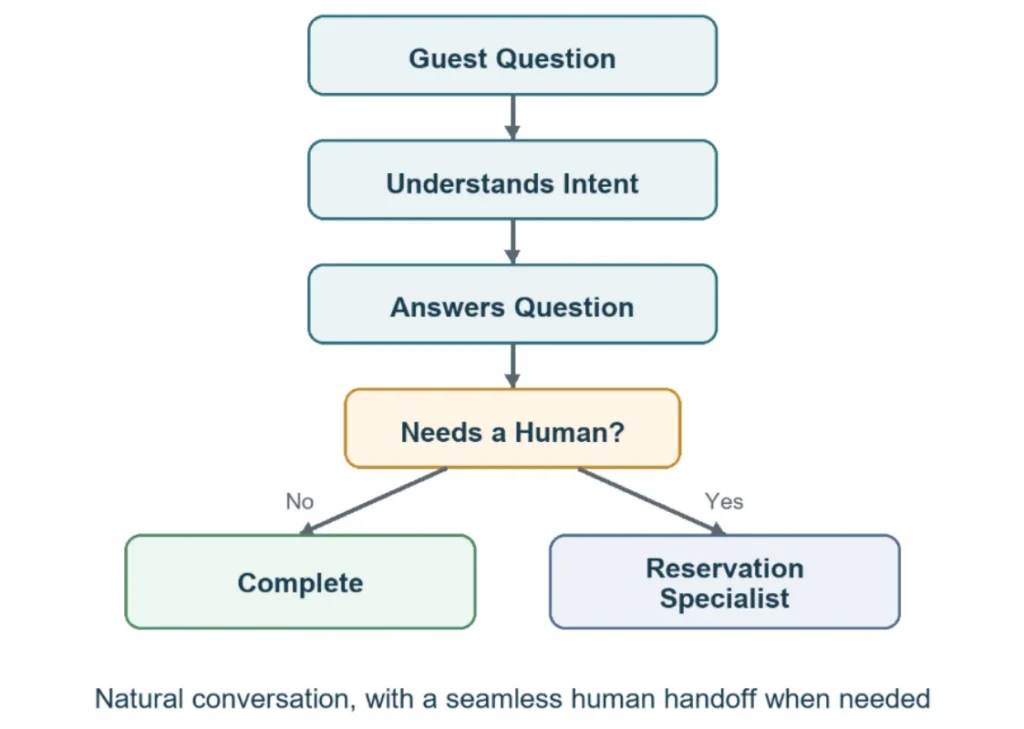
The Evolution of Hotel Guest Communications
Hotel communication technology has moved through distinct eras. Each era reduced some work, but only the latest stage begins with the way guests actually speak.
| 1995 | Static FAQs | Hotels publish answers; guests search for them. |
| 2005 | Rule-Based Chatbots | Prewritten replies handle predictable keywords and paths. |
| 2010 | IVR Automation | Telephone menus route calls and automate basic choices. |
| 2020 | Conversational AI | Systems interpret intent and respond in natural language. |
| Today | Guest-Led Conversational AI | Guests lead; AI follows context, supports the request, and brings in people when needed. |
Why Hotels Are Moving Beyond Chatbots for Customer Service
The move is not being driven by novelty. It is a practical response to pressures that hotel teams manage every day.
Staffing pressure. Front desk and reservations teams cannot be everywhere at once. Routine calls compete with arriving guests and complex service issues.
Higher guest expectations. Travelers compare the hotel experience with the immediate, intuitive service they receive in other parts of their lives.
Multilingual travel. Hotels welcome guests with different languages, accents, and communication preferences; rigid scripts create avoidable barriers.
Rising call volume. Amenity questions, reservation inquiries, directions, policies, and pre-arrival requests can arrive in waves that exceed on-property capacity.
A 24/7 service standard. Guests plan and travel outside business hours. A missed question can become a missed booking or an anxious arrival.
Revenue and reputation. Fast, accurate answers influence booking confidence, direct conversion, reviews, and whether a guest feels cared for before reaching the property.
Traditional chatbots can absorb a narrow slice of this demand. Guest-led conversational AI can cover more of the conversation while protecting the handoff to a person when empathy, judgment, or sales expertise matters.
For hotels, the benefits extend beyond convenience. More natural guest conversations can help reduce abandoned calls, increase reservation conversion, improve guest satisfaction, lower pressure on front desk teams, and strengthen direct booking performance.
What Natural Hotel Conversations Look Like
The difference becomes clearest in ordinary guest moments.
Guest: “Can I bring my dog?” The AI explains the property’s pet policy, fees, restrictions, and any next step instead of sending the guest to search an FAQ page.
Guest: “We’re arriving around midnight.” The AI recognizes a late-arrival need, explains check-in procedures, confirms what the guest should expect, and routes the conversation if the reservation needs attention.
Guest: “We’re celebrating our anniversary.” The AI recognizes that the guest is sharing more than a fact. It can explain available celebration options or connect the guest with someone who can personalize the stay.
Guest: “My mother uses a wheelchair. Will the room work for her?” The AI treats accessibility as a specific, high-trust request, provides verified property information, and involves a trained associate when confirmation is essential.
Guest: “Do you have two rooms near each other for us and the kids?” The AI identifies a family-travel need, gathers the relevant details, and supports the reservation conversation without forcing the caller into departmental language.
Why Hospitality Requires a Different Approach
Hospitality is not a generic customer-service category. A hotel conversation may be the first human-or-digital contact in a trip that a guest has planned for months, saved for, or tied to a major life event. The emotional stakes are often higher than the words alone suggest.
Emotion and anticipation
Vacations carry anticipation. Weddings carry pressure. Anniversary trips carry meaning. A parent arranging family travel may be balancing budgets, bed types, adjoining-room requests, and everyone’s expectations at once. Good hospitality communication recognizes that the request and the feeling behind it often arrive together.
Trust and accuracy
Guests make decisions based on details that must be reliable: cancellation terms, accessibility, pet policies, transportation, parking, dining hours, and room configurations. Hospitality AI should be grounded in property-specific knowledge, transparent about its limits, and ready to involve a person when certainty matters more than speed.
Accessibility and inclusion
Natural communication is especially important when a guest needs accessible accommodations, communicates in another language, has a strong accent, or finds menu-driven technology difficult to navigate. The system should reduce barriers, not require the guest to learn the system’s vocabulary.
Complex, connected journeys
A hotel inquiry can move from availability to room choice, from a pet policy to a reservation, or from a late arrival to transportation and dining. Hospitality-focused AI must retain context across those turns so the guest does not have to repeat the story.
The human moment
Some conversations should never be trapped in automation. Service recovery, sensitive accessibility questions, VIP arrangements, complex group needs, and emotionally charged situations call for judgment and empathy. The best systems recognize that boundary and make the transfer feel like a continuation, not a restart.
What Guest-Led Conversational AI Looks Like in Hospitality
Modern hospitality-focused conversational AI platforms have emerged to address these challenges. One example is Annette, The Virtual Hotel Agent™, which was developed specifically for hotel guest communications.
Annette is designed to support property-specific questions, reservation inquiries, intelligent routing, follow-up communication, and multilingual interactions while allowing guests to speak naturally. The objective is not to imitate hospitality with a script. It is to remove repetitive friction, create a consistent first response, and make it easier for hotel teams to focus where people add the greatest value.
AI and Hospitality Work Better Together
The strongest operating model is an AI + Human Hybrid Model. AI handles repeatable, high-volume interactions; hospitality professionals handle the conversations that depend on judgment, emotion, persuasion, or recovery.
• Personalized reservation guidance and conversion
• Complex or unusual requests
• VIP and celebration planning
• Service recovery
• Sensitive accessibility needs
• Relationship building
This is not a choice between automation and hospitality. It is a way to give hospitality professionals more room to practice hospitality while giving guests faster access to information and assistance.
Why This Matters
As AI becomes part of everyday hotel operations, the question is no longer whether hotels should automate guest communications. The question is whether that automation improves or complicates the guest experience. The answer increasingly depends on how naturally guests can communicate.
The Future of Hotel Guest Communications
Within the next several years, conversational AI is likely to become as common in hotels as online booking engines are today. Guests will increasingly expect to communicate naturally with hotels across voice, text, and digital channels without navigating menus or waiting on hold.
The channels will matter less than the continuity of the conversation. A guest may begin with a voice question, receive a text confirmation, continue digitally, and reach a person without repeating the request. Property knowledge will become more connected, multilingual service more accessible, and routine assistance more consistently available around the clock.
The competitive advantage will not come from deploying the most automation. It will come from designing the most useful guest journey: accurate when facts matter, natural when conversation matters, and human when the moment demands it. Hotels that build that model now will be better prepared for a future in which natural communication is not a novelty but an expectation.
Common Misconceptions About Conversational AI
Myth: Conversational AI replaces hotel staff. Reality: It handles routine conversations so staff can focus on high-value guest interactions.
Myth: It is just a smarter chatbot. Reality: It understands context, intent, and natural language across multi-turn conversations.
Myth: Guests prefer speaking with people every time. Reality: Guests generally prefer getting accurate answers quickly, with seamless access to a person when needed.
Frequently Asked Questions (FAQs)
What is a hotel chatbot?
A hotel chatbot is a digital interface that typically uses scripted responses, rules, or decision trees to answer common guest questions.
How is conversational AI different from a chatbot?
A traditional chatbot usually matches keywords or follows predefined paths. Conversational AI interprets natural language, understands intent and context, and responds dynamically.
What is guest-led conversational AI?
Guest-led conversational AI lets travelers express needs in their own words while the technology adapts to the conversation, maintains context, and supports the next step.
Can conversational AI support hotel reservations?
Yes. Hospitality-focused platforms can answer property questions, support reservation inquiries, identify booking intent, and transfer guests to trained reservation professionals when needed.
Does conversational AI replace hotel employees?
No. The most effective model combines AI for routine demand with people for complex, emotional, revenue-sensitive, and relationship-driven conversations.
Why are hotels moving beyond IVR systems?
IVR systems require callers to navigate menus. Guest-led conversational AI allows callers to state what they need naturally, reducing friction and improving routing and assistance.
Can hospitality conversational AI support multiple languages?
Yes, depending on the platform. Multilingual capability can reduce communication barriers, but hotels should confirm language coverage, property knowledge, and escalation procedures before deployment.
Continue Exploring Hotel Guest Communications
This topic connects to the broader transformation of hotel reservations, call capture, service quality, and the voice channel:
Foundations
• Navigating the Complex World of Conversational Hotel AI – Part 1
Direct Revenue
• Selecting the Right Hotel Call Center
Reservations
• Navigating the Complex World of Conversational Hotel AI – Part 2
Operations
See How Hotels Move Beyond Chatbots
Guests expect immediate answers, personalized service, and seamless communication. Travel Outlook combines hospitality-trained professionals with Annette, The Virtual Hotel Agent™, to help hotels answer more guest inquiries, support reservations, reduce front desk pressure, and preserve the human touch.
See how Travel Outlook and Annette help hotels move beyond traditional chatbots, IVR systems, and scripted automation to create more natural guest conversations.
Schedule a demonstration with Travel Outlook.
#Hospitality #Hotel #HotelIndustry #GuestExperience #HospitalityTech #HotelTechnology #HotelOperations #HotelRevenue #HotelManagement #TravelOutlook #HotelCallCenter #CallCenter #ConversationalAI #GuestLedAI

About John Smallwood, President of Travel Outlook | John Smallwood is President of Travel Outlook, The Premier Hotel Call Center™, and a recognized thought leader in hotel guest communications, conversational AI for hotels, hotel reservations, hotel call center operations, and hospitality technology. A veteran hotel owner, developer, and operator, John has spent decades helping hotels improve guest experiences, increase direct bookings, optimize reservation conversion, and maximize voice channel revenue.
After earning a BBA from New Mexico State University, John began his career with AT&T, where he gained valuable experience during the early years of the data revolution. He later combined his expertise in hospitality operations and technology to found Travel Outlook, creating one of the hospitality industry’s leading reservation services organizations focused exclusively on hotel guest communications. John also led the development of Annette, The Virtual Hotel Agent™, a guest-led conversational AI platform built specifically for hotels. Through his writing, speaking engagements, webinars, and industry collaborations, John helps hotel leaders understand how conversational AI and human expertise work together to improve guest service, strengthen reservation performance, reduce operational pressure, and create more personalized guest experiences. Learn more at LinkedIn.com/in/TravelOutlookVoiceReservations.

About Travel Outlook, The Premier Hotel Call Center™ | Travel Outlook is a leading provider of hotel call center outsourcing, hotel reservations services, conversational AI for hotels, and guest communication solutions. Serving as either a hotel’s primary or overflow reservations department, Travel Outlook combines highly trained hospitality professionals with hospitality-specific AI technology—including Annette, The Virtual Hotel Agent™—to help hotels answer every guest call, improve reservation conversion, increase direct bookings, and enhance the guest experience.
Known for its progressive approach to hotel reservations, call center performance, training, transparency, quality assurance, and hospitality technology, Travel Outlook helps hotels optimize one of their most valuable revenue channels: the voice channel.
Travel Outlook’s client portfolio includes many of hospitality’s leading brands and management companies, including Grand Casino Mille Lacs and Grand Casino Hinckley, Viceroy Hotel Group, Curator Hotels and Resorts, Outrigger, Proper Hospitality Group, MakeReady Experience, Pechanga Resort Casino, Ocean Edge, Shanty Creek, Sage Hospitality, Noble House Hotels, HEI Hotels, and many others.
By combining hospitality expertise with conversational AI, reservation sales best practices, and data-driven performance management, Travel Outlook helps hotels improve guest satisfaction, strengthen brand loyalty, increase direct revenue, and deliver exceptional guest experiences across every interaction. Learn more at TravelOutlook.com.
About Annette, The Virtual Hotel Agent™ | Annette, The Virtual Hotel Agent™, is a guest-led conversational AI platform designed exclusively for the hospitality industry. Purpose-built for hotel guest communications, Annette helps hotels answer every call, support reservations, reduce front desk workload, and deliver personalized guest experiences 24 hours a day, 365 days a year.
Powered by advanced conversational AI, natural language understanding (NLU), hospitality-specific knowledge bases, and intelligent call routing, Annette understands how real guests speak—including complex questions, multi-turn conversations, varying accents, and multiple languages. Unlike traditional IVR systems and basic chatbots, Annette engages guests in natural conversations that feel intuitive, helpful, and personalized.
Annette can answer property-specific questions, support reservation inquiries, assist with room availability, route calls intelligently, send follow-up text messages, communicate in multiple languages, and seamlessly transfer guests to hotel staff whenever human assistance is needed. By combining AI with hospitality expertise, Annette helps hotels improve call capture, increase reservation opportunities, enhance guest satisfaction, and create a modern guest experience that complements hotel teams rather than replacing them. Learn more at TravelOutlook.com/Annette.